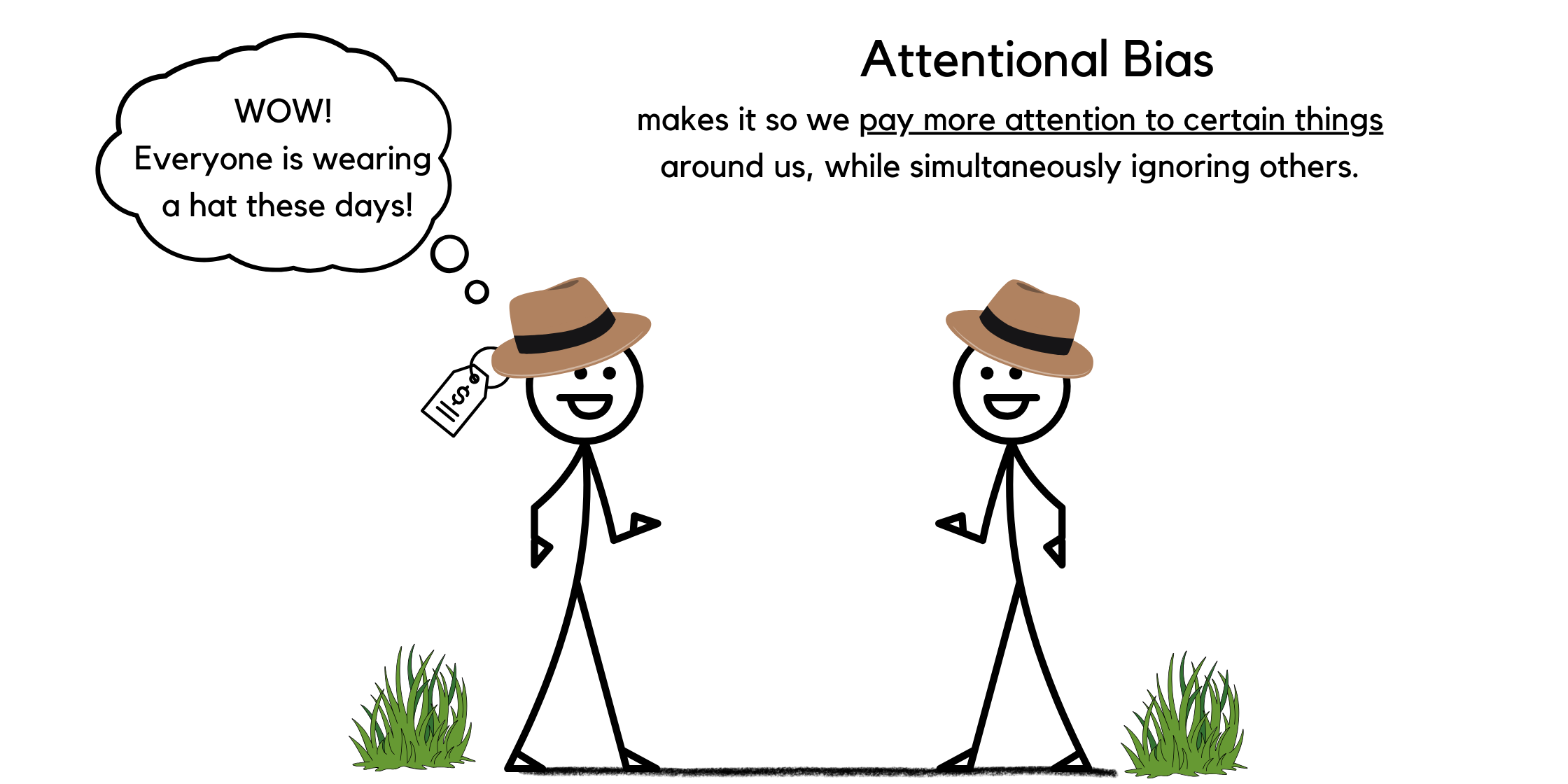
Attentional bias can make us miss obvious details or social cues, sometimes leading to funny or awkward situations.
Last summer, I gave a talk to a small hospital system in Wisconsin. The event took place in an old church that had been converted into an event center. I spoke from the altar in a room with low lighting.
After my keynote, I walked to my book table at the back of the church and noticed a woman in a flowered dress who looked about six months pregnant. My daughter Christine was also about six months pregnant, and I’d had dinner with her the night before, so pregnancy was on my mind.
A few moments later, the woman in the flowered dress came over to buy a book. It was dark at the back of the church, but I realized she was the same person I had seen before.
I gave a signed book to the man in front of her, then turned to the woman in the flowered dress and, without really looking at her, asked, “When are you due?”
Silence. Just silence.
My heart dropped as she slowly shook her head and said, “I’m…. not….. pregnant. I have a forty-five-year-old daughter.”
I was mortified. I had just made a mistake I’d managed to avoid for 65 years.But then I made things even grimmer.
Instead of just apologizing, I blurted out, “Oh, are you ill?” which only made things worse.
“No,” she said, shaking her head slowly, clearly confused by my lack of manners. A simple apology would have been enough.
She reluctantly handed me a book to sign and told me her name was Patty. My mind was racing, and I accidentally wrote “Fatty,” quickly scratched it out, set the ruined book aside, and grabbed another to write “Patty.”
Patty gave me a $10 bill for the book. My husband Steve stood behind me, grumbling and whispering things I couldn’t quite hear. I took her money, and she walked away looking a bit dazed.
I turned to Steve and muttered, “Oh my gosh, I really messed up.”
Steve just shook his head and said, “Whoa.” He laughed quietly and said, “First, you offend her, and then you took her money. Amy, I was trying to tell you not to take her money.”
This is an example of attentional bias, where we pay more attention to one thing than others, often because it has emotional meaning or connects to our own experiences.
I had seen my daughter the day before and was excited about her pregnancy. Patty wore an empire-waist dress that looked like a maternity dress, which is a style I often wear too. Unfortunately, I focused on her dress instead of noticing other clues, like the fact that she was too old to be pregnant.
Here are a few more examples of attentional bias:
The New Car Phenomenon is when, after you buy a certain car model, you start seeing it everywhere. The cars were always there, but now your focus makes it seem like everyone else has the same car.
People who are depressed often notice, interpret, and remember things in a negative way. They may have trouble shifting their focus from negative to positive.
Studies show that doctors are much more likely to recommend knee replacement surgery sooner for men than for women with the same symptoms. This happens because they may unconsciously believe women exaggerate pain, which leads to women being under-treated.
A few minutes later, I went up to Patty again and apologized for my mistake. She looked a little afraid of me at first, but she graciously accepted my apology. For the record, she is pretty and not at all fat. It really was just the style of her dress. Maybe I need to rethink my own empire-waist dresses.
Usually, it’s Steve who makes mistakes like this, not me. I’m not proud to admit it, but all I could think about was how I might blame this on Steve. Was there any way I could make this his fault?